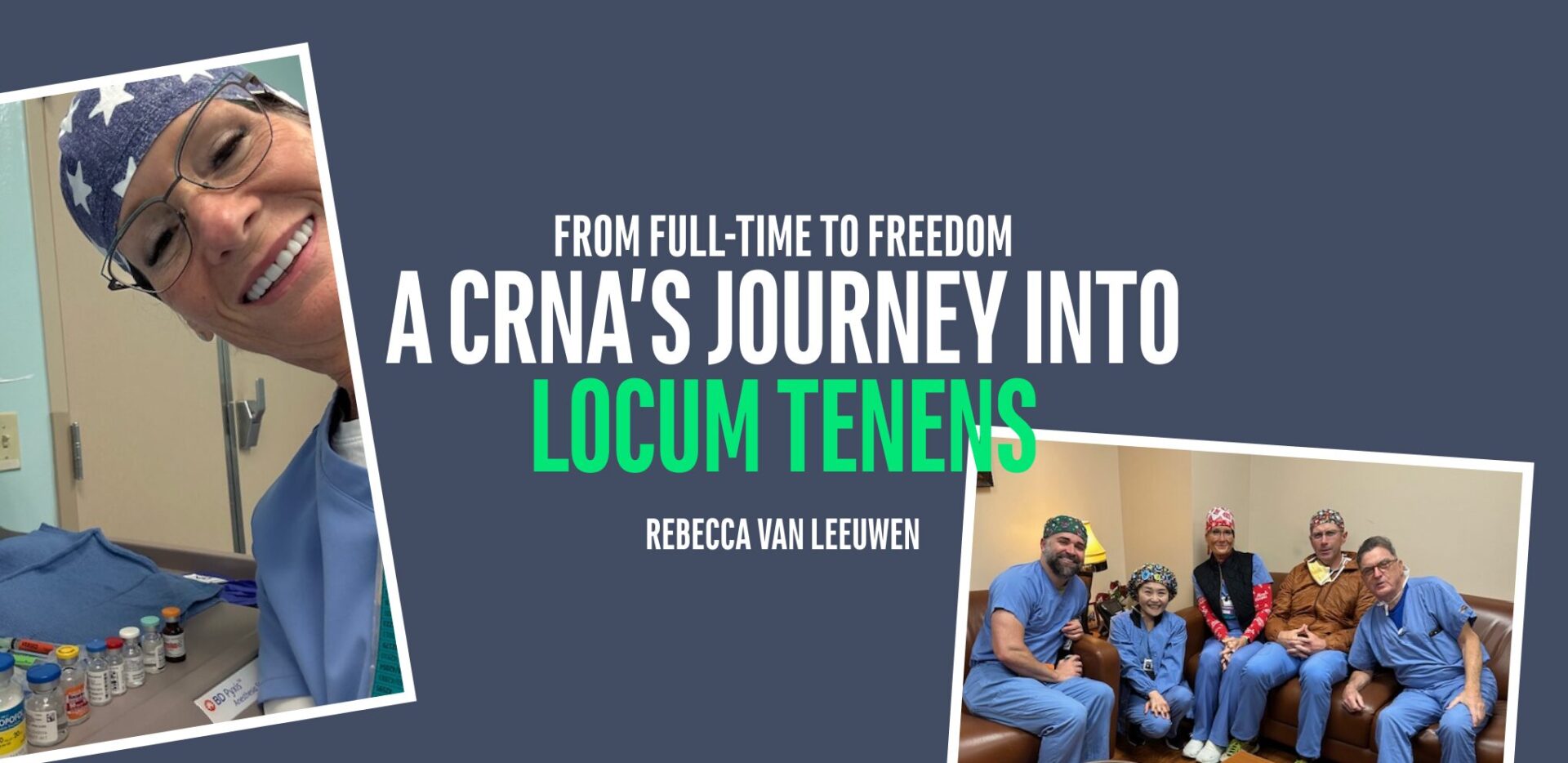
Locum tenens can offer opportunities for CRNAs to earn a great income while having more control over their schedules. We sat down with CRNA Rebecca Van Leeuwen to get an inside look at how locum tenens has improved her work-life balance, and what the CRNA locums experience looks like.
What led you to become a CRNA?
I always wanted to be a nurse. I went to nursing school, and about 15 years into my nursing career, I realized I wanted more. I tried the administrative route, and I didn’t like that—I preferred taking care of patients.
I talked to a friend who had recently graduated from a Nurse Anesthesia Program, and after she explained the process, I decided to look into it. It took a while to get through school, and it was a challenging experience, but ever since I finished, I’ve been so happy. I’ve never looked back!
What made you decide to try locum tenens as a CRNA?
After 12 years of being employed full-time as a CRNA in a major trauma facility, I felt like I had a lack of voice in my schedule and practice, and was getting to the point in my life where I wanted more control over where I was and what I was doing.
I tried doing short-term shifts in multiple local facilities, but I realized I preferred being in one place for a time instead of going to a different facility every day. I like being in one place on a regular basis, and locums gives me that opportunity.
With locum tenens, I can stay at one location, get to know people, and understand their routines—that’s what keeps me interested.
What were your concerns about locum tenens? Did your consultant help address them?
My main concern with locum tenens was working with a consultant. I felt like I was throwing my decisions and work preferences into the hands of a stranger I’d never worked with before, just like my patients do with me.
My Hayes Locums consultant, Lucas, always responded with: “I’ve got you.” And when I went into my first locums assignments, sure enough, he did.
What’s the best part about being a locums CRNA?
I am amazed by patients who don’t know me, have never met me, yet they place their trust in me to put them to sleep. They have no control over what happens, no recollection, and no knowledge—and they trust me to protect them and watch out for them. That’s a big deal to me.
While CRNAs are not directly involved in surgery, the trust patients have in us has made me realize the depth of responsibility we have.
What is your work-life balance like with locum tenens?
I’m able to balance my free time better than I could when I was working full-time in a hospital. Requesting time off is more accessible in locums, and I can request it without feeling bad about it. In a full-time position, I had to wait for permission. Now, I can just say, “This is when I need off,” whether it’s for a graduation or a wedding, or I just want to take time for myself.
I finally feel like I have control over my schedule. I want to be able to go home every weekend where I’m grounded, rejuvenated, and reconnected with my real life.
I have a really good situation with my home life and my work balance, and I appreciate that so much.
How do locums CRNAs help address healthcare disparities in rural areas?
I’ve realized even more the importance of CRNAs when I’m working in underserved areas. A lot of people don’t move back to rural areas once they leave. You have providers who go get their education, and more often than not, they stay in cities. That means rural areas struggle to get sufficient healthcare of any kind.
If it weren’t for CRNAs and locums, underserved areas would not have enough help. The providers who work at rural hospitals would burn out, and it would start to impact the quality of care. Without CRNAs looking out for rural America, it would be difficult for them to get access to good-quality anesthesia.
What advice do you have for CRNAs considering locums?
When you walk into a facility as a locums provider, patients count on you. You’ve got to be able to understand and listen. You need to be adaptable and capable of reading the room.
When I started working with Hayes Locums, I had a phone interview with a chief CRNA in rural Texas. I wasn’t sure if I wanted to take the assignment, and I didn’t think he would hire me because I didn’t want to do on-call or weekend coverage, but we ended up having a great interview! Lucas called me back and said, “I don’t know what you did, but he wants you to go.” Later, I found out it had to do with my experience, knowledge base, and ability.
The facility I interviewed with was in a position where they needed someone to come in and hit the ground running. They get you a computer, they get you access to the medications, and then they walk away, and you’re in charge. You need to be able to do that.
For CRNAs feeling constrained by traditional employment models, locums can be a great way to take control of your schedule and have a voice in your practice. Rebecca Van Leeuwen’s journey is an example of how locum tenens can not only transform your schedule, but also make a meaningful impact on healthcare access in underserved communities.