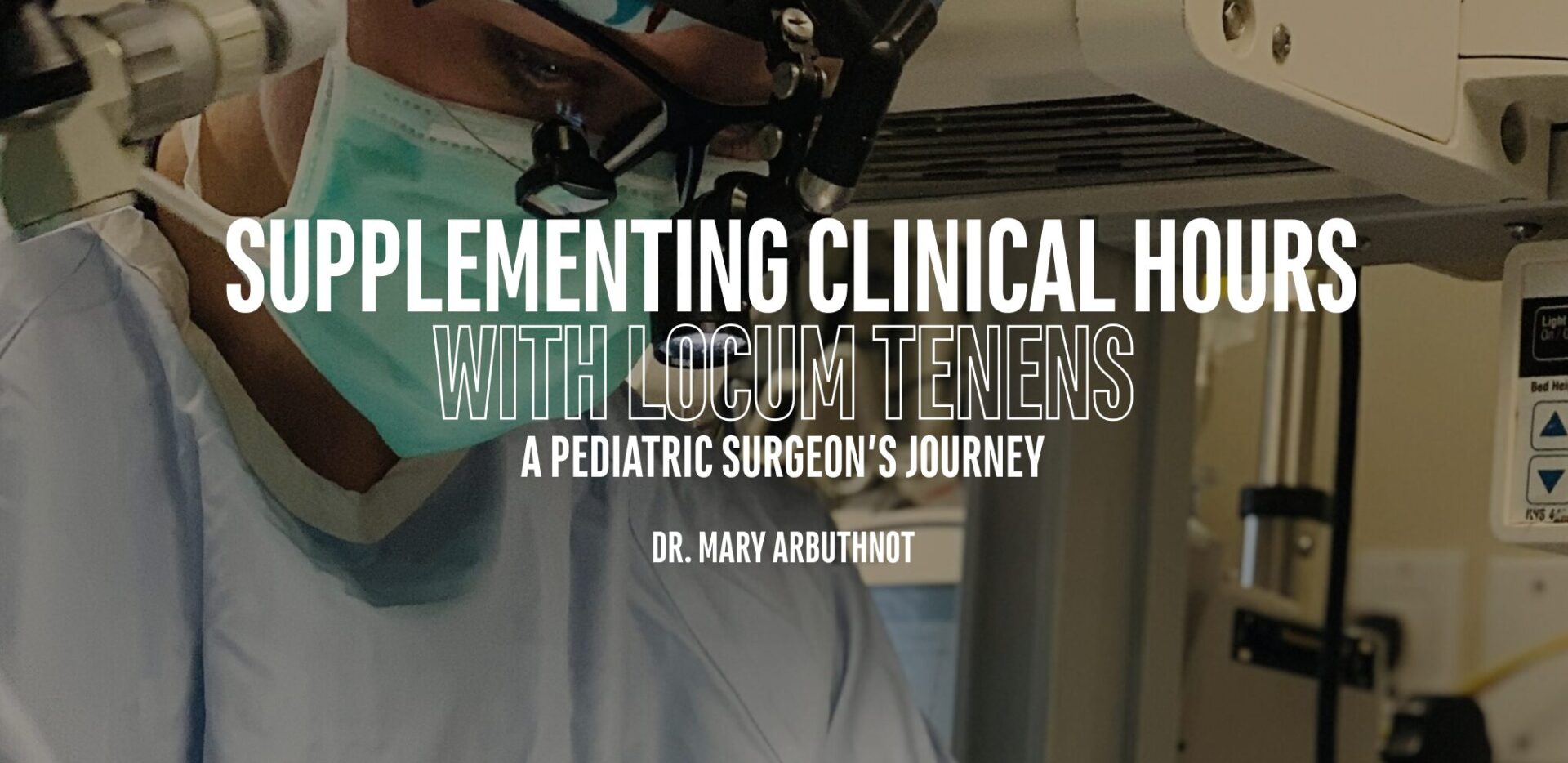
Locums doesn’t have to be a full-time commitment. Physicians can use part-time locums to expand their clinical experience beyond the scope of their full-time practice.
Dr. Mary Arbuthnot, who balances locums with her full-time career as a military pediatric surgeon, is a shining example. Her thoughtful approach to locums shows how providers can use locum tenens as a strategic career tool to broaden their clinical experience and expand professional networks—all while maintaining a strong sense of work-life balance.
Why did you become a pediatric surgeon?
I knew from the time I was a little girl that I wanted to be a doctor, and later, when I was in medical school, I discovered my love for the operating room.
I was naturally inclined to work with children and motivated by a desire to make a difference in their lives as a swim instructor and Sunday school teacher during my college years. It wasn’t until my second year of general surgery residency—when I rotated through pediatric surgery—that I truly discovered this field was the perfect integration of my passion for surgery and my desire to care for infants and children.
What I find most interesting about pediatric surgery is the opportunity to work with the unique and complex congenital anatomical variations found in children that necessitate attention to detail, fine, and gentle tissue handling, and an ability to connect with not only the patient, but the entire family. The children are so innocent and kind. They have such a zest for life and a will to survive that is rarely encountered elsewhere.
By my third year of residency, I was convinced I wanted to pursue pediatric surgery. It felt like a calling placed on my heart.
What is your favorite part about being a pediatric surgeon?
What I love about this job is knowing you can make immediate improvements. Nobody likes to see a surgeon unless they really need us. So when people are feeling their worst and need an operation, you’re able to take that patient and make them feel better.
Seeing children recover—watching a baby who couldn’t eat, guzzle down a bottle of milk following recovery from surgery, or removing a port-a-cath after a child’s gone into remission—and then witnessing the gratitude in their parents’ eyes for guiding their child’s treatment and recovery—that’s immensely rewarding.
Although pediatric surgery involves its share of difficult cases, most children do remarkably well. Overall, the field is profoundly gratifying, offering both meaningful successes and opportunities to make a lasting impact.
Why did you start doing locums?
I began working locum assignments early in my career as a general surgeon prior to specializing in pediatric surgery.
I’ve spent the majority of my career in the military—primarily within military treatment facilities—which are smaller, community-sized hospitals. I recognized from the outset the importance of supplementing my practice with locum work to gain broader exposure to higher patient volumes and greater clinical acuity.
After I finished my pediatric fellowship, I connected with Hayes Locums and set up a locums schedule to increase the diversity of my clinical experience. It’s been an incredible way to stay busy and clinically active within the constraints of having a full-time job.
Early in my pediatric surgery career, staying busy became crucial to remaining clinically relevant. Locums has helped me increase my case numbers and gain exposure to different environments and approaches. It has also allowed me to be very professionally adaptable, so I can fine-tune my soft skills and equip myself to succeed across a range of clinical environments.
What does a day in the life of a locums pediatric surgeon look like?
I spend a weekend a month doing locum assignments at two different facilities, both of which have busy neonatal intensive care units, Level One trauma capabilities, and Extracorporeal Membrane Oxygenation (ECMO) services.
During one shift, I received a call from the neonatologist at 5 AM saying that a patient was transferred from a local military hospital and required emergent ECMO. I was able to cannulate the child onto ECMO before the end of my last shift on that assignment.
Several months later, while I was deployed, my partner at the military hospital sent me a picture of that beautiful baby and her family, who extended their gratitude. That was an especially meaningful experience for me, seeing that thriving military family as a result of the care I was able to provide that early morning in my capacity as a locum surgeon.
What are some misconceptions about locum tenens?
Many people assume locums work must be a full-time commitment, but that’s not always the case. You can work part-time locums to complement your primary practice, whether to generate additional income, expand your case volume, or simply to add variety.
The breadth of locums opportunities available surprised me. The experience can truly be tailored to your individual goals and interests.
Is there something you bring with you as a “must-have” to your locums assignments?
On my locums assignments, I must have a small suitcase and a “go” bag. The suitcase stays at the hotel, and my “go” bag contains extra scrubs, a toothbrush, spare socks, water, and perhaps the most essential of all, a little bit of chocolate, just in case I don’t make it back to the hotel. This allows me to remain flexible and prepared, regardless of assignment location or proximity to the hotel.
And then, of course, I have my Operating Room (OR) playlist that goes with me on every assignment. I am known for playing a variety of tunes in the OR that keep the mood light and create an environment of warmth and positivity to the best of my ability. I’m convinced that a positive environment directly enhances the quality of patient care.
When the operating room runs late into the night, my favorite song to play is “Everything is Awesome” from The Lego Movie. The song is catchy, relentlessly upbeat and punchy, celebrating everything as positive—even when it isn’t. The humor, and also the lesson, lies in that contrast, revealing that whether something feels “awesome” or not often depends on how you choose to frame the situation.
Do you have any other advice for surgeons considering locums?
Do your homework and be intentional about whom you choose to work with. Seek a consultant who understands your goals and matches those goals with the hospital’s priorities. Ensure you’re getting what you want out of the experience, not only in terms of case numbers and hours, but also with respect to fair compensation.
Remember that word of mouth goes a long way, too. Another advantage of locums is the opportunity to build a reputation for yourself. The medical community is small, and locums allows you to network among your peers, which can open the door to future opportunities.
Do you have any advice for women in surgery?
When I began training 15 years ago, there weren’t many female surgeons with children in the military. That’s the biggest change I’ve seen. Nearly all of the female surgeons I work with now have families.
The biggest message for women considering surgery as a career is that although there will be sacrifices, you don’t have to sacrifice the dream of being both a surgeon and a mother. It demands strong organizational skills and adaptability, but it’s entirely doable, and it’s increasingly more common.
Whether you’re looking to build clinical skills, expand your professional network, or simply add variety to your practice, the right locums partnership can help you achieve your goals while maintaining the work-life balance that matters most. Dr. Arbuthnot’s story shows that with the right approach and support, locums can be a powerful complement to any physician’s career path.