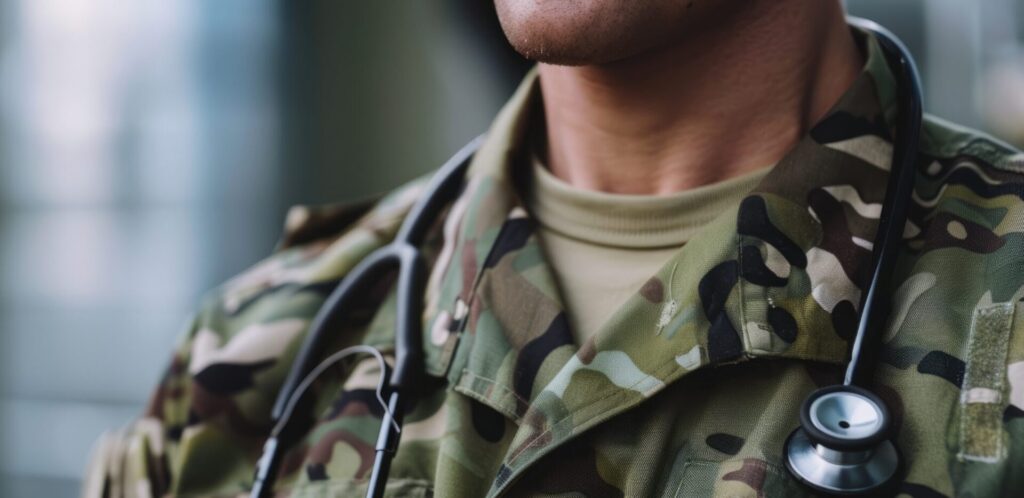
At Hayes Locums, we are honored to have so many providers with military experience: those who have served, those who are currently serving, and those who work with veterans. This Veterans Day, we’re sharing some of their stories.
“We’re very well-prepared as military physicians, in part because a lot of military training has to do with what you’re going to do in a deployed setting, where you don’t have all the resources, staff, or instruments you normally have. Having that experience of being able to navigate different ways of doing things, figuring out how to make do with what you have, makes walking into a locums environment fairly smooth and easy.
The adaptability we learn in the military helps us works in a locums environment, but the locums environment also helps us take new ways of doing things back to the military.”
–Dr. Aurora Vincent, Locums ENT
“We have a way of practicing oncology in the military that isn’t necessarily the experience outside. We don’t have to worry about insurance issues, and our patient population is a bit healthier than the baseline, particularly with active duty folks.
On the military side we get to do a lot of our own procedures––I’ve put in central lines and pik lines, I’ve done lumbar punctures and bone marrow biopsies and intrathecal chemotherapies. In the civilian world, a lot of that is deferred to other departments. So when I go to a locums assignment, they like to schedule intrathecal chemotherapy procedures for when I’m there, and they’re always kind of shocked that I know how to do it.
I love taking what I’ve learned through locums and bringing it back to my military practice, and vice versa. That’s what’s made locums one of the most enriching parts of my career, and one of the best decisions I’ve made.”
–Dr. Taylor Barnett, Locums Cardiologist
“One of the things that you learn in the military is to do the best job you can with what you’ve got. You learn to be flexible and make the best of any situation. That’s a good philosophy to bring to your work, especially locums work.
People who are physicians within the military also understand teamwork––you know you’re not going to get your way every day. If a hospital doesn’t happen to have a tool you’re used to, you figure out a way to work around that. You learn to be flexible, to work with a group. The military teaches you a different kind of structure––the nurses are officers just like you, the administrators are officers just like you, the OR nurse that you work with may outrank you––and that structure teaches you how to be a better colleague. And those are good life skills to have.”
–Dr. Courtney Beebe, Locums Urologist
“I did my family medicine internship with the Navy, and then served nine years active duty as a flight surgeon. I decided to transition to the reserves when I did my civilian pediatric residency, because I wouldn’t be able to do residency and active duty at the same time. But I wanted to stay with the Navy, because I really liked what I was doing as a flight doc.
Now I have the best of both worlds: I get to be a Pediatric Hospitalist on the civilian side, and I still do sports medicine work with my Navy sailors.”
–Dr. Jane Benson, Locums Pediatric Hospitalist
“I do teleconsultation with six state-run veterans homes. My job there is to deal with dysregulated behavior and to reduce and hopefully eliminate the use of antipsychotics. [In my time there], we’ve dramatically reduced the use of antipsychotics in geriatric patients. It’s rewarding work. For these patients, their horizon is close, their future is short. And we want them to be able to enjoy as much as they can for as long as they can without being over-sedated, and without being at risk of harm to self or others.
I love this work. If somebody asked me what my job is, it’s two things. One is to reduce shame, and the other is to instill hope. And I’m able to do that.”